Opening the conference, Deputy Chief of the State Police and Head of the Main Public Order Police Department, Andris Zellis, emphasised the strategic importance of emerging technologies: “New technologies – drones, artificial intelligence, and other solutions – are currently among the most vital security issues. The responsibility of law enforcement authorities is to remain one step ahead of those who seek to threaten public safety. International cooperation and the exchange of experience enable us to adopt the latest solutions and strengthen security not only in Latvia but also across Europe and globally.”
To promote cooperation and knowledge exchange among European countries regarding new technologies as a security resource, their practical application, and their impact on public safety, the conference featured presentations by 11 international experts. These included representatives from Kharkiv National University of Internal Affairs and the National Academy of the National Guard of Ukraine, the Directorate of Special Units of the Austrian Federal Ministry of the Interior, and law enforcement authorities from Italy, Poland, Ireland, Spain, Lithuania, and the Czech Republic, as well as the Police Academy in Szczytno, Poland. Latvian experts also contributed to the programme, representing the State Police, the Ombudsman’s Office, Rīga Stradiņš University, and the Internal Security Academy.
On the first day of the conference, October 8, participants shared practical experiences ranging from drone management and deployment in Austria, the Czech Republic, and Ukraine to Ireland’s experience in counter-UAS (C-UAS) operations and preparations for the European Union Presidency in 2026. Opportunities for cooperation with the Rīga Stradiņš University Business Incubator B Space were also presented, highlighting its role in fostering innovation. In addition, discussions addressed legal regulation and data protection, the use of drones in public safety and crime prevention, the opportunities and challenges of artificial intelligence for law enforcement authorities, and the protection of critical infrastructure. Particular attention was paid to how new technologies are reshaping society and perceptions of security.
“The State Police College continuously identifies and adopts international best practices to develop new tools for law enforcement authorities more rapidly, efficiently, and effectively, in synergy with existing resources. Drones, or flying robots, are becoming an integral part of everyday police work – much like cars and motorcycles once did. I believe that in the near future, drones will provide comprehensive support for traffic monitoring, helping to save human resources and increase operational efficiency. Technology has the potential to make our work safer, more transparent, and more effective,” stated Dmitrijs Homenko, Director of the State Police College.
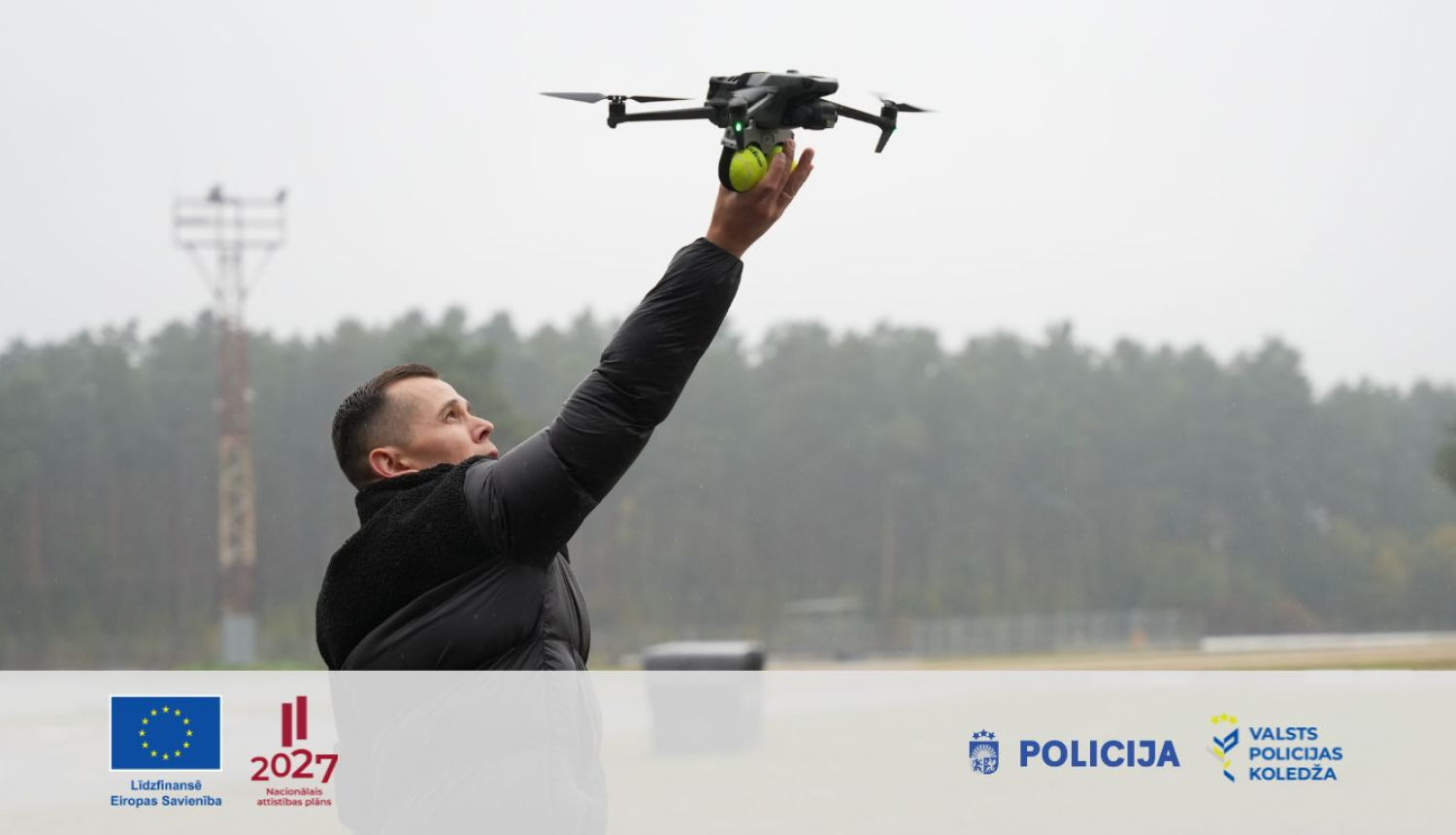
On the second day of the international conference, October 9, the first drone competition organised by the State Police took place at the Biķernieki Complex Sports Base. The objective of the competition was to enhance drone piloting skills, promote the exchange of experience, and strengthen cooperation among law enforcement authorities, thereby jointly improving airspace protection and surveillance. Eight teams participated, representing the State Police, the State Fire and Rescue Service, the State Border Guard, and the National Guard. Participants tested their piloting and teamwork skills by completing six challenging tasks, including rescue simulations, precision delivery of objects, and flying complex manoeuvres. Among the eight competing teams, the State Border Guard team emerged as the winner.
“In recent years, technology has become an integral part of security and operational work – it helps to optimise human resources, protect officers, and enable safer responses to threats. However, the human factor remains fundamental: a professional and well-trained officer who is capable of using these technologies effectively. Only by combining technological capabilities with human competence can we achieve maximum results,” noted Māris Vitkovskis, Head of the Technical Support Management Division of the Resources and Crisis Management Department of the Main Public Order Police Department of the State Police.
The conference and competition were organised within the framework of the project implemented under the 2021-2027 planning period of the Internal Security Fund, whose leading institution in Latvia is the Ministry of the Interior. Project No. VP/IDF/2024/5, “Strengthening the response mobility and anti-terrorism capabilities of the State Police by creating a practical training center,” has a total funding of 10 598 882 euros, of which the European Union's Internal Security Fund funding is 7 949 162 euros, and 2,649,720 euros is funded from the state budget.. The project implementation period is from April 1, 2024, to December 31, 2029. The overall purpose of the project is to increase the effectiveness of police counter-terrorism efforts and to strengthen mobile response and investigative capacities by assessing and improving training content, providing a modern theoretical and practical training environment, and applying innovative training methods and equipment.